


In California, you have more chances to change or buy a Medicare Supplement plan without medical underwriting than seniors in almost any other state. California stacks extra protections on top of the standard federal windows.
- California is one of the few states with a “birthday rule” that lets you shop your coverage every single year.
- If you lose employer or retiree coverage, you get a full six-month window to buy a plan, not the usual 63 days.
- If a Medicare Advantage plan drops your coverage, California adds an extra 60 days onto your federal window.
- And if you lose Medi-Cal because your income or assets went up, that opens a guaranteed-issue window too.
These are real, money-saving rights, but only if you know they exist. Miss the window, and you could be locked into whatever you have today. Here’s what you need to know about how Medigap guaranteed issue works in California.
What “Guaranteed Issue” Means
Guaranteed issue means the insurer must sell you the plan and can’t deny you or charge more. In most guaranteed-issue situations, they also can’t impose a waiting period for preexisting conditions (during your first enrollment at 65, a short waiting period can still apply if you didn’t have prior creditable coverage).
Compare this to the usual practice—outside of these guaranteed issue windows, most Medigap applications require medical underwriting and can turn down your plan application.
This is the difference between shopping freely and being locked into whatever you have today, whether your employer’s health plan, Medicare Advantage, or a lower-benefit Medigap plan.
Your First Guaranteed-Issue Window: Medigap Open Enrollment
This is the 6-month window that opens when you’re 65+ and enrolled in Part B. It’s the one time everyone gets full access to any plan, any carrier, without any questions asked about your health. This is a use-it-or-lose-it window, and you don’t usually get another one just like it.
People who get Medicare under 65 due to disability get their own six-month open enrollment when Part B starts.
Guaranteed-Issue “Trigger” Situations
Some life, insurance, or employment events will trigger an additional guaranteed-issue window. These include:
- Losing employer/retiree coverage
- A Medicare Advantage plan leaving your area
- You’ve moved out of a Medicare Advantage or Medigap plan’s service area
- Trial-right situations (tried MA within the first 12 months and want to go back).
Most states give you the federally guaranteed 63-day window to qualify. California honors those same federal windows but often gives you more. For example, a full six-month window if you lose employer or retiree coverage, and an extra 60 days if a Medicare Advantage plan drops you.
California’s Standout Feature: The Birthday Rule
California residents can benefit from a unique Medigap guaranteed issue rule.
Every year, on your birthday, a 60-day window starts allowing you to switch Medigap plans with no health questions. This is a guaranteed-issue right most states don’t offer. What does this “switch” entail?
You can switch carriers.
You can switch plans with your current carrier.
You can switch the plan and carrier.
In some states, you can’t change carriers, only plans. California allows you to make several changes during your Birthday Rule window.
Your insurer must tell you about this right between 30 and 60 days before your birthday window opens, and again on any notice about a benefit change or premium increase. From your birthday, you then have 60 days to switch your coverage.
However, you must already have a Medigap policy. You can only move to a plan with equal or fewer benefits. You cannot use it to upgrade to “richer” coverage.
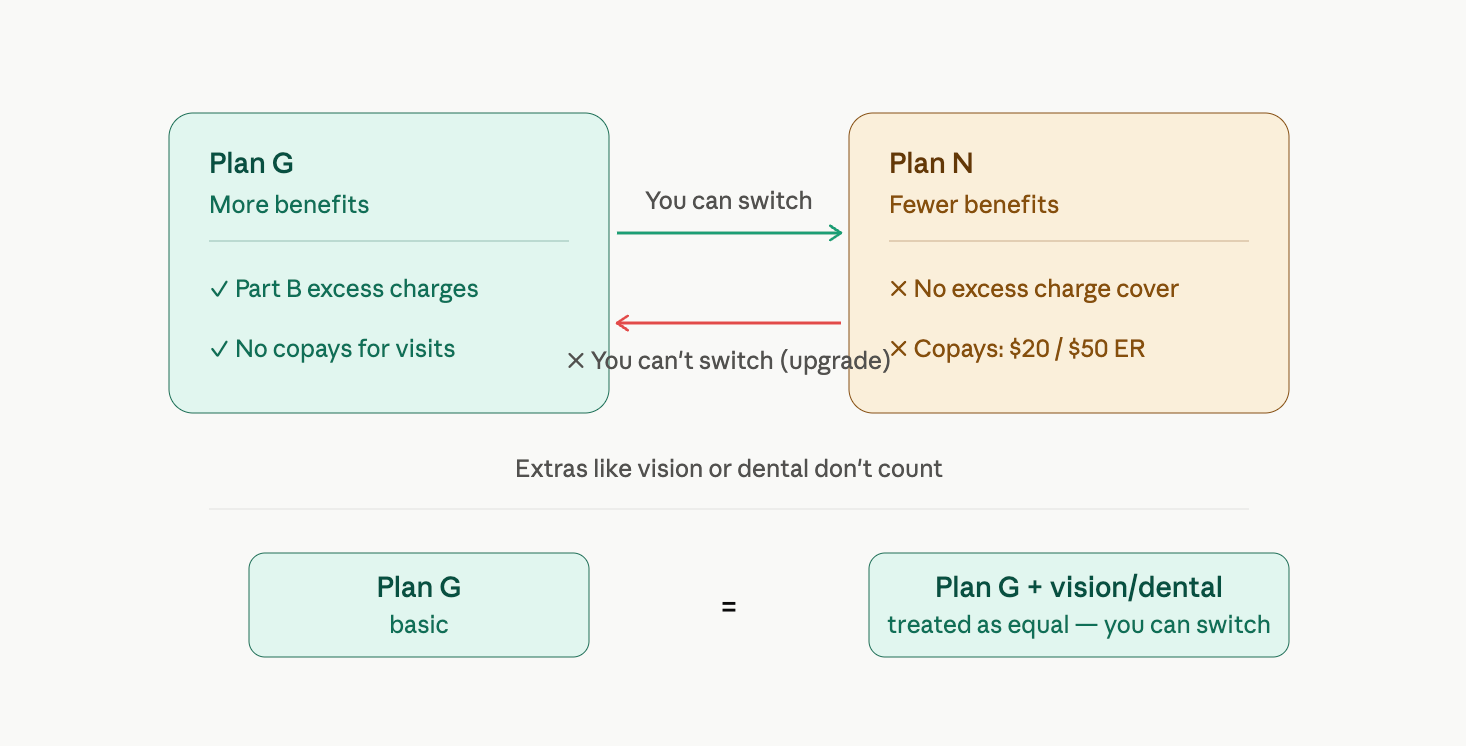
When comparing plans, extras like vision or dental don’t count. These extras are often included in “innovative” plans. So a basic Plan G and an Innovative Plan G are treated as having the same benefits. That means you can switch between them under the birthday rule.
This is particularly helpful if you want to shop for a better price. Identical lettered plans cost different amounts across carriers, and rates change over time. The birthday rule ends up being a way to “shop your rate.” You might save a few dollars, or you might save more, depending on your plan letter, age, where you live, and other factors. You can even use it every year, and it won’t hurt you or raise your rate.
Set a reminder 30–45 days before your birthday to shop around, but be careful to never cancel the old plan until the new one is approved.
California’s Under-65 Protection
California is one of the few states that require insurers to sell Medigap to people under 65 who have Medicare due to disability. However, insurers don’t have to offer every plan to under-65 applicants generally, and instead typically offer a core set of Plans A, B, D, and G.
When your Part B starts, you get a six-month open enrollment with access to all of that insurer’s plans. Premiums for under-65 enrollees may be higher, but you have options many states don’t provide. And once you have a plan, the birthday rule applies to you too.
Common Mistakes That Cost People Their Rights
- Missing a time window
- Canceling coverage first
- Assuming they’re “too old” to switch
- Trying to upgrade under the birthday rule
- Never shopping because they assume all Plan Gs cost the same.
Learn More
Your rights don’t expire, and health can’t be used against you in these windows. Contact me for a no-cost plan review, and contact California’s HICAP program for free, unbiased counseling.
Notice: We do not offer every plan available in your area. Any information we provide is limited to the plans we offer. Please contact Medicare.gov or 1-800-MEDICARE to get information on all your options.
Frequently Asked Questions
When exactly does my window start, on my actual birthday, or the first of my birth month? And how long is the window — 59, 60, or 63 days?
The guaranteed issue window starts on your actual birthday, and California’s birthday rule lasts for 60 days. Many people confuse it with Idaho/Wyoming’s 63 days.
Does California have year-round guaranteed issue like New York or Connecticut?
No, California gives windows for a period of time (60 days, around two months), not open access all year.
I moved to California from another state, so which rules apply now?
Your Medicare Supplement rights are based on where you live, so once you’re a California resident, California’s birthday rule applies. Keep in mind you may also have a separate, shorter federal window because you moved out of your old plan’s service area — so if that applies, act quickly.
